Better shelf-edge design is better retail execution
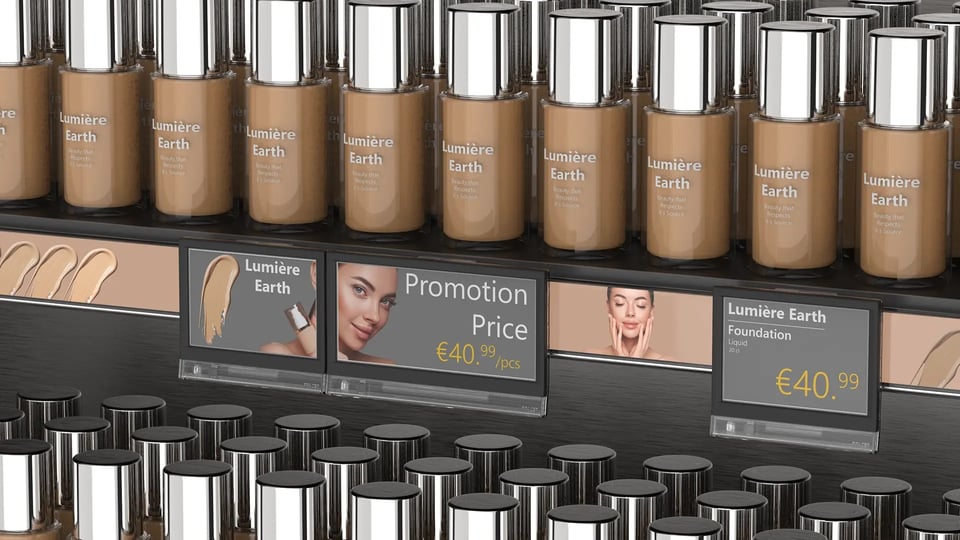
Retail technology at the grocery store shelf edge is generally judged by how fast it updates, how accurately it prices and how much labour it saves, but some retailers are asking an additional question, how well does it meet the needs of the shopper?
This is important because the shelf edge has become one of the most operationally active and commercially important spaces in retail. It is where pricing changes take place, promotions land, waste is reduced, stock visibility improves and customer decisions are made.
And yet, for all the strategic importance of the shelf edge, much of the technology deployed there has been designed around technical constraints rather than retail realities and only captures a part of what the shopper expects. Pricer Avenue™ has changed that.
Battery-free ESL solution for the shelf edge
Designed from the ground up as a battery-free, modular shelf-edge platform, Pricer Avenue represents a different way of thinking about the shelf edge where prices are part of a connected retail infrastructure designed for longevity, flexibility and better in-store communication.
The result is a solution where industrial design is about appearance but also how it shapes how the technology performs, evolves and scales. Pricer Avenue uses an energised shelf-edge rail to power labels directly, and so removes the dependency on individual batteries entirely. This transforms the shelf edge from a collection of independent devices into an integrated system. This removes the need for individual battery replacement cycles, reduces maintenance overhead and simplifies long-term ownership.
But it also changes the design equation. Without the need to design around battery housing and battery replacement, the product can become slimmer, lighter and more adaptable. As Nikolaus Frank, Head of Design at Pricer, explains, “Good design is never just about form. It’s about removing unnecessary complexity and creating something that works better over time.
With Avenue, eliminating the battery allowed us to rethink the entire architecture of the shelf edge.” Nikolaus brings a wealth of experience and a passion for user-centred design, co-founding the renowned industrial and graphic design company Frank Etc. AB in 1994.
Nikolaus is known for his innovative designs, often featuring a high technological content and a clear design language. The company has been recognized with numerous awards, including several Good Design Awards, Excellent Swedish Design awards, the Industrial Design Excellence Award (IDEA), and the iF Award for Good Industrial Design.
Winner of the 2026 Green GOOD DESIGN Award
Pricer Avenue’s design-led approach has already gained external recognition, winning a 2026 Green GOOD DESIGN Award from The Chicago Athenaeum, Museum of Architecture and Design and The European Centre for Architecture Art Design and Urban Studies, one of the world’s oldest and most established design awards programmes, founded in 1950 by design pioneers including Charles and Ray Eames, and Eero Saarinen.
The Green GOOD DESIGN Awards recognise products and systems that combine innovation with meaningful environmental impact, celebrating solutions that reduce waste, lower resource consumption and rethink sustainability at a systems level.
That recognition matters because it reinforces what Pricer Avenue represents, not simply a better-looking shelf-edge system, but a fundamentally different infrastructure model for retail, sustainable design in its truest sense, where aesthetics, functionality are designed together, not treated as separate priorities.
For instance, design for Pricer Avenue has been concentrated on reducing complexity and introducing greater flexibility. Retail environments are often messy; shelf configurations vary, promotions change constantly and product ranges evolve.
New way of communicating with floating canvas displays
Traditional ESL deployments often mirror that complexity with dozens of label sizes, multiple hardware variations and fragmented visual consistency. Pricer Avenue’s ambition is to reduce clutter and provide the shopper with a simple homogenous experience that exceeds their expectations.
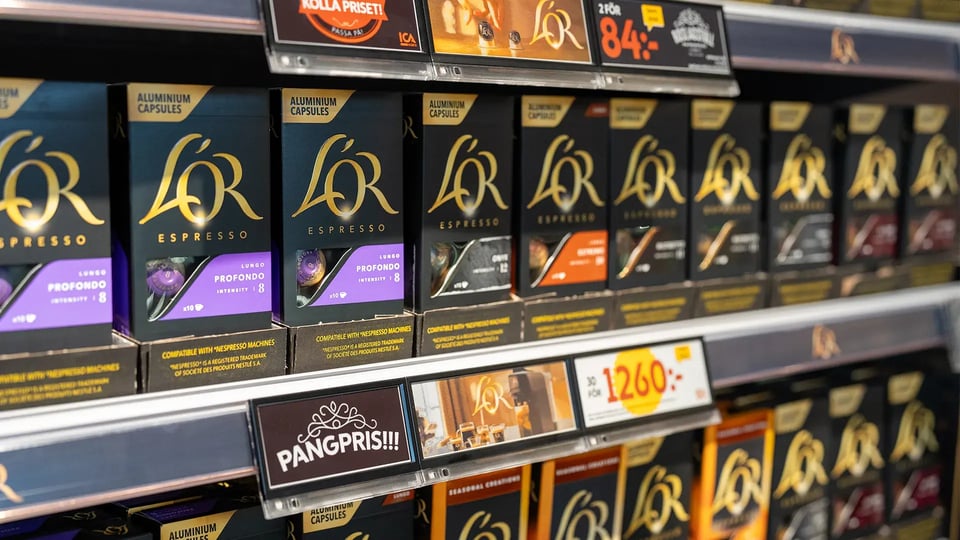
The system is harmonised into just four core display formats, designed to work together as part of a larger visual system. Through Pricer’s floating canvas capability, multiple labels can function as one continuous communication surface, enabling graphics, promotions and brand messaging to extend seamlessly across the shelf edge.
This is a design decision, but it also changes the role of the shelf edge itself, to create a pricing and communication platform. For retailers, that opens up new opportunities to improve promotional visibility, strengthen brand consistency and create more premium in-store environments.
More sustainable retail environment
One of the least discussed challenges in retail technology is an inflexible lifecycle. Many systems are deployed as fixed-generation infrastructure meaning that when the technology advances, the upgrade path often needs replacing.
Pricer Avenue was designed differently. Its modular, backward-compatible architecture means retailers can upgrade over time without replacing the entire shelf-edge infrastructure. Internal components can evolve while preserving the broader system investment. The platform enables continuous software updates without hardware replacements, extending both its lifetime and usability.
The implications are less waste, lower future capital costs and faster innovation adoption. Frank explains, “Retail environments change constantly. The infrastructure supporting them should be able to change too. We designed Avenue with that in mind from day one.”
This means that sustainability must be built in by design, embedded in the Avenue product architecture itself, as part of Pricer’s sustainability commitments. Battery elimination is the most obvious example, but it is not the only one. The labels use less plastic through thinner construction.
Flexible PCB design reduces electronic material usage while supporting slimmer profiles and better structural performance. Even the locking mechanism has been redesigned to reduce mechanical complexity while improving store usability.
These design choices together reduce material usage, extend product life.
Do you want to know more about how you can enhance the shelf edge experience?